getvram.com — the layer, not the GPU farm

Your GPU.
Running one workload
at a time. While the rest waits.

getvram gives every container a VRAM grant. Tenant A exceeds it and gets a local OOM. Tenant B keeps serving. The runtime is MIT. The cut is commercial.

docker-compose.yml
# Before getvram: choose ONE container to use the GPU
services:
  llm:
    image: ollama/ollama
    # ❌ Consumes ALL 8 GiB — other containers OOM-killed
    deploy:
      resources:
        reservations:
          devices:
            - driver: nvidia
              capabilities: [gpu]
docker-compose.yml — getvram
# After: every service gets exactly what it needs
services:
  llm-inference:
    image: ollama/ollama
    runtime: vram
    labels:
      vram.limit: "6144m"      # ✅ 6 GiB grant
      vram.priority: "high"

  embedder:
    image: my-embedder
    runtime: vram
    labels:
      vram.limit: "1024m"      # ✅ 1 GiB, auto-burst if idle

  training:
    image: pytorch/pytorch
    runtime: vram
    labels:
      vram.limit: "2048m"      # ✅ 2 GiB, BestEffort QoS
      vram.priority: "low"
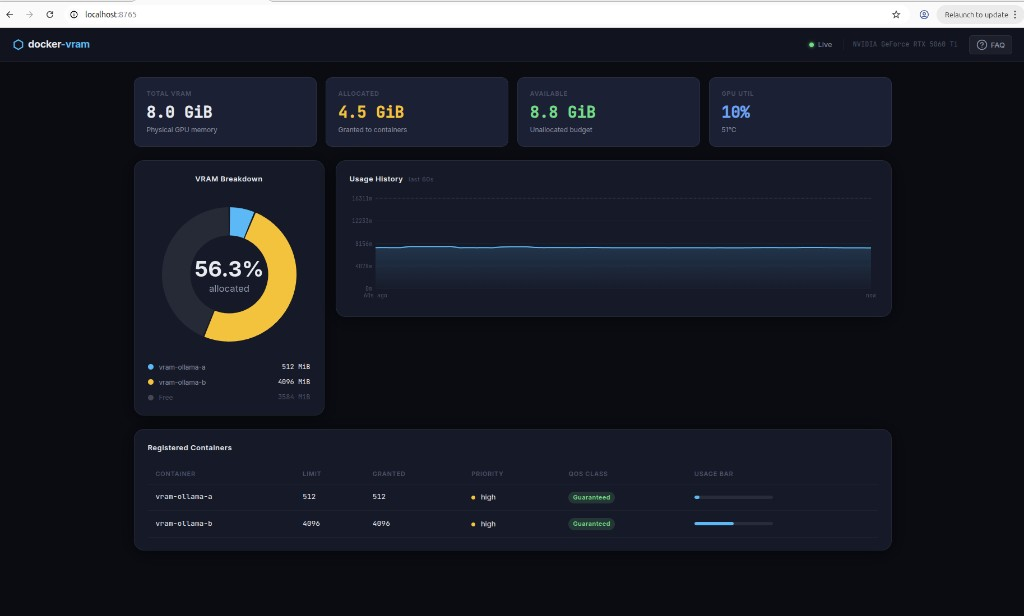
Two Ollama tenants on one GPU — vram-ollama-a at 512 MiB, vram-ollama-b at 4 GiB
vram-ollama-a (512 MiB) blows the grant. vram-ollama-b (4 GiB) is still serving.

Every AI developer knows this pain

💀

OOM cascades

Container A grabs all 8 GiB. Container B crashes with CUDA out of memory. You kill A. You restart B. Repeat.

⚙️

Driver configuration hell

nvidia-container-toolkit, CUDA versions, WSL2 passthrough, MPS server setup. Hours of config before you write a single line of model code.

🐌

Sequential bottleneck

Your GPU sits at 5% utilization while your LLM waits between requests. Every other container is blocked waiting for it to finish.

🔒

No isolation

One misbehaving container corrupts shared GPU state. MPS offers no memory isolation — a crash in one process can kill the entire GPU context.

GPU Virtual Memory Management.
Not software multiplexing.

getvram doesn't sit between your container and the GPU as a proxy. It speaks directly to the CUDA Driver API at the GPU MMU level — the same abstraction layer used by NVIDIA's own virtual GPU (vGPU) products.

01

Virtual address reservation

At startup, cuMemAddressReserve carves a virtual address space equal to your total GPU VRAM. No physical memory is allocated yet.

02

Per-container physical handles

When a container registers (via OCI hook), cuMemCreate allocates a physical VRAM block sized to that container's quota. The handle is transferable across process boundaries.

03

Isolated virtual mapping

cuMemMap + cuMemSetAccess binds each physical handle to a unique virtual address slice per container. Container A's GPU pointers are completely disjoint from Container B's — enforced at the hardware MMU.

04

Zero-copy hot resize

When a container is idle, its physical pages can be remapped to a bursting container in microseconds. No data movement. No kernel panic. One cuMemUnmap + cuMemMap.

Host (vram-daemon)
CUDA VMM Engine
cuMemCreate · cuMemMap · cuMemSetAccess
↕ IPC socket (OCI hook)
Container A — LLM
VA: 0x0000 – 0x17FF
6 GiB · Priority: HIGH
Container B — Embedder
VA: 0x1800 – 0x1BFF
1 GiB · Priority: NORMAL
Container C — Training
VA: 0x1C00 – 0x1FFF
1 GiB · Priority: LOW

Why not MPS, MIG, or time-slicing?

Feature NVIDIA MPS NVIDIA MIG Time-Slicing getvram
Memory isolation ❌ None ✅ Physical ❌ None ✅ VA-level (MMU)
Dynamic resizing ❌ Static ❌ Requires reconfiguration ⚠️ Burst only ✅ Hot-resize in μs
Supports any CUDA version ✅ ⚠️ A100/H100 only ✅ ✅ Pascal+
Works in Docker Desktop ❌ ❌ ❌ ✅ Linux Docker · vram run on Mac
Per-container OOM kill ❌ Cascade ✅ ❌ ✅ Isolated
Configuration required MPS server setup Hardware + profile Driver flag Zero — docker labels
Apple Silicon (M-series) ❌ ❌ ❌ ✅ Metal MTLHeap (v2)

You run it on your GPU.
We don't host anything.

Software license, one node. Not SaaS. Not a cluster product. Kubernetes is not for sale because it is not built.

MIT runtime
$0
  • Free Docker plugin and vram command
  • Put a VRAM number on a container (vram.limit=4g)
  • On Linux the container actually sees the GPU
  • vram init writes a compose file for Ollama

The number is a label. Nobody enforces it. A greedy neighbor can still take the card.

GitHub

Questions people actually type

Can two Ollama or vLLM containers share one NVIDIA GPU?

With --gpus all they share the device, not the memory. The first cudaMalloc often takes the card. The second dies with CUDA OOM. getvram gives each container a VRAM ceiling. Over that ceiling is a local OOM. The neighbor keeps generating.

Does the MIT GitHub repo enforce vram.limit?

No. docker-vram is the runtime and CLI. Containers start. Labels are recorded. There is no daemon in that repo. Enforcement is the paid getvram grant on your machine.

Does this work on a Mac?

Docker Desktop is a Linux VM. Host Metal cannot see those containers. On Apple Silicon use vram run --limit=1g -- ollama serve. Unified memory: the product is the quota, not a cascade OOM onto a neighbor.

Is getvram a GPU cloud?

No. You install it on hardware you already own. We do not rent GPUs and we do not host your models.

Two models. One GPU.
The neighbor keeps answering.

Leave your email if you want the cut on your card. The MIT runtime is already on GitHub. We do not rent GPUs.

No credit card. If the site cannot reach a waitlist server, a copy stays in this browser until you clear it. Cookies · Terms